
Companion Planting Inside Polytunnels
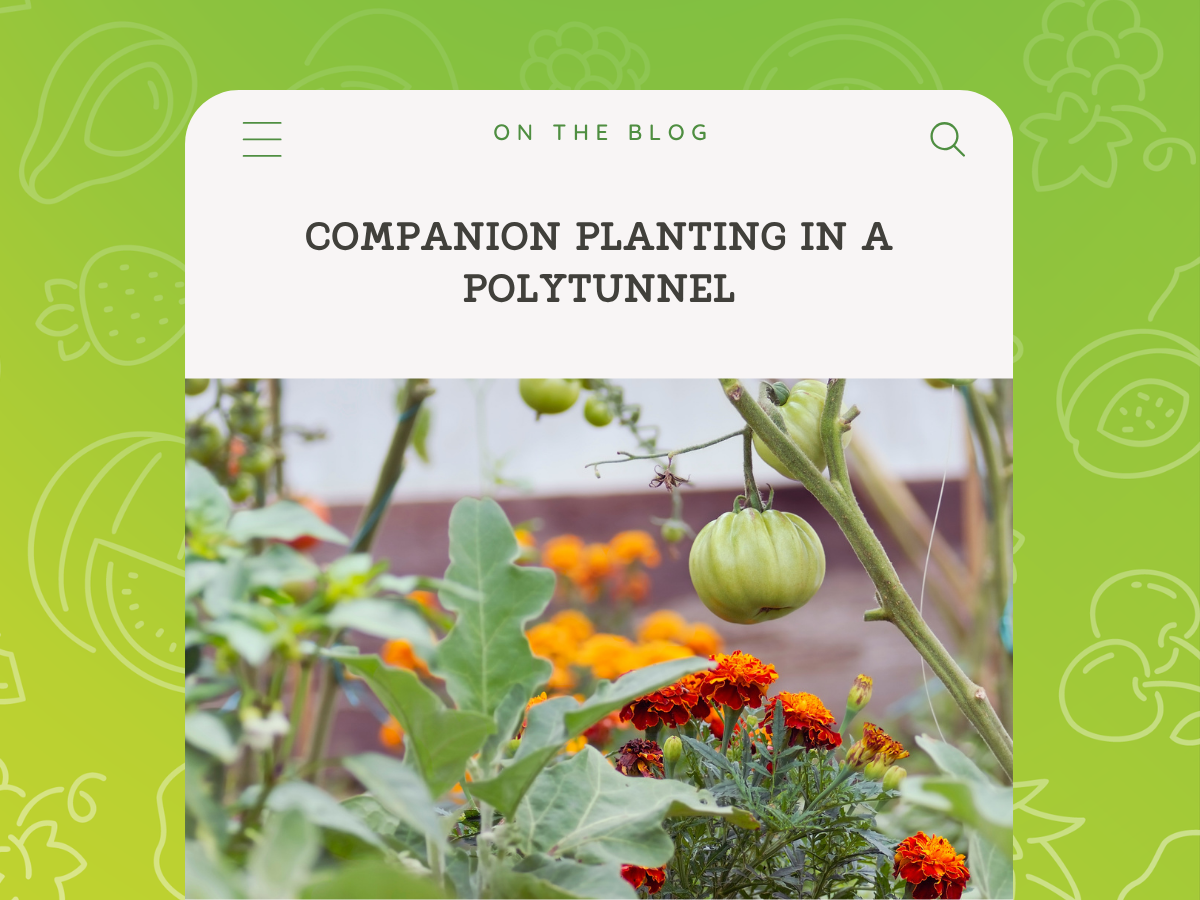
Companion planting at a glance…
Companion planting means growing different crops together with a practical purpose, such as using space efficiently, combining harvest times or providing flowers for beneficial insects.
Inside a polytunnel, choose combinations around mature plant size, light, water requirements and airflow.
Short-season crops can occupy space around young, slower-growing plants, provided they are harvested before the bed becomes crowded.
Companion planting can support pest management, but no plant pairing guarantees protection.
Start with one manageable mixed bed, observe how it performs and adjust your next planting.
A productive polytunnel doesn’t need every bed filled with the same crop.
Tomatoes, leafy greens, herbs and flowers can all have a place in a thoughtfully planned growing space. The challenge is choosing combinations that remain practical once the plants are fully grown.
That’s where companion planting comes in.
For Australian home growers, it can be a useful way to diversify harvests and make better use of a tunnel. For market gardeners, carefully planned interplanting may create additional cropping opportunities, provided it fits the irrigation, access and harvesting system.
The starting point is simple: understand what each plant needs, then plan how the crops will share the space.
What is companion planting?
Companion planting is the practice of growing different plants near one another to achieve a particular benefit.
That benefit might be:
Harvesting a quick crop before a slower crop fills the bed.
Combining upright plants with smaller crops that utilise more ground space.
Providing flowers that offer food for beneficial insects.
Keeping a useful selection of vegetables and herbs within easy reach.
Some combinations are supported by research. Others come from gardening traditions, with less evidence behind the claims. Nonetheless, experiment with some of these tips and find the right mix for your polytunnel.
A useful approach is to ask: what job is this companion plant doing?
If the answer is “providing a second harvest before the main crop needs the space”, you have a clear reason to try it. If the answer is “keeping every pest away”, the expectation needs adjusting.
Why does companion planting need extra planning inside a polytunnel?
A polytunnel gives you a protected growing space, but that space still can still be optimised to maximise your harvests.
Plants share the available light, soil moisture and nutrients. Their leaves and stems also affect airflow and your ability to harvest and care for your crops with ease.
A layout that looks generous at planting time can become difficult to manage once tomatoes are climbing, cucumbers are spreading and herbs have filled out.
Before combining crops, consider:
How large each plant will become.
When you expect to harvest it.
Where its leaves and roots will grow.
How you will irrigate the bed.
Whether you can still inspect, train and harvest the main crop.
Companion planting works best when it supports the everyday work of growing.
How do you choose suitable companion plants?
Start with the crops you actually want to harvest
Your tunnel space is valuable.
Before adding a companion plant, decide whether you want its harvest, flowers or another specific function. A herb you use every week may deserve space beside a vegetable crop. A large plant included only because a chart recommends it may be a waste of crucial growing space.
For home growers, begin with your household’s regular meals. What do you eat on a weekly basis, and then add in some of those more expensive grocery cart items such as herbs and seasonal vegetables.
For market growers, consider customer demand and whether the additional crop is worth the time required to manage and harvest it.
Plan for mature size
Draw the main crop into your bed plan first, using the spacing recommended for its variety and growing system.
Then consider whether a smaller crop can fit without taking away the space the main crop needs.
Companion planting should not become a reason to ignore recommended spacing. Allow room for foliage, roots, supports and access.
Match the timing
Fast-growing crops can be useful companions to slower crops when their harvest windows are planned carefully.
For example, a short-season leafy crop may be ready to remove while a newly planted fruiting crop is still establishing. The important part is harvesting the smaller crop before competition becomes a problem.
Think of the bed as a changing space rather than a fixed arrangement.
Check light and irrigation needs
Notice where shadows fall throughout the day. Tall crops and trellises can change conditions for everything around them.
Also consider whether the crops suit the same irrigation approach. A shared bed needs a watering plan that reaches both crops without repeatedly overwatering one to satisfy the other.
Grouping plants by practical growing needs is more useful than relying on a long list of supposed “friends” and “enemies”.
Practical companion planting combinations to try
The following are starting points for a small trial. Adjust them for your varieties, season and actual tunnel conditions.
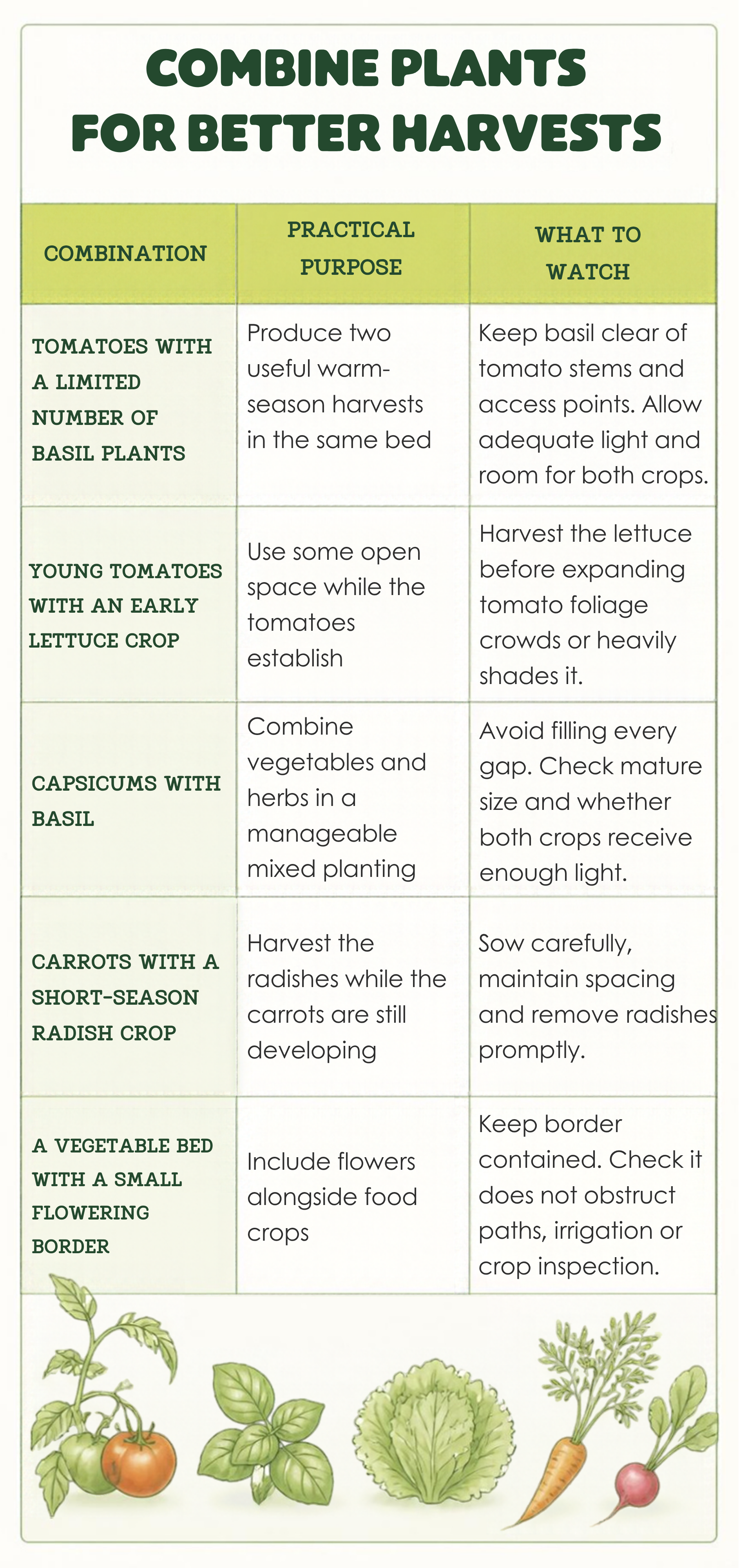
Interplanting examples including basil with capsicums and radishes with carrots. These offer practical layout ideas, rather than a promise that every combination will perform equally well inside every tunnel.
planting tomatoes and basil together
For many home growers, the most straightforward benefit of planting these two staples together is harvesting two ingredients they regularly use. Start with a small number of basil plants rather than creating a dense understorey beneath the tomatoes. Always ensure both plants will still have enough space, light and water.
Some basil–tomato combinations can affect particular pests. That does not mean basil will prevent all insect problems or guarantee better-tasting tomatoes, in fact in some cases it can sacrifice itself for the benefit of your tomato!
leafy greens & taller crops
When it comes to growing leafy greens and taller plants timing matters.
An early crop may use space around young plants successfully, then struggle once the taller crop develops a full canopy.
Watch how the light changes. If the greens become crowded or difficult to reach, harvest them and give the main crop the room it needs.
Avoid treating every shaded patch as automatically suitable for another planting.
Flowers for pest-management inside a polytunnel
Flowers can provide nectar and pollen for beneficial insects. Mixed planting may also affect how some pests locate their host plants.
However, results depend on the plant, pest, conditions and access available to insects. A marigold beside a crop is not a universal pest barrier.
Inside a screened tunnel, beneficial insects may have limited access. Flowers alone cannot solve that.
Keep companion planting within a broader management routine:
Inspect plants regularly.
Identify insects before deciding how to respond.
Remove badly affected material where appropriate.
Maintain suitable crop spacing.
Monitor irrigation and ventilation.
Record recurring problems.
Start with a modest flowering area. Observe what visits it and whether it remains useful without becoming another crop-management task.
How does insect mesh affect pollination?
Insect exclusion and pollination need to be considered together.
If mesh limits insect access, crops that depend on insect pollination may need a deliberate pollination plan. Simply adding flowers inside the tunnel does not ensure pollinators will reach them.
Cucumbers are a useful example because varieties differ. Some require pollination, while many greenhouse varieties can set fruit without it. Follow the supplier’s advice for your chosen variety rather than applying one rule to all cucumbers.
Before planting, check the pollination requirements of each fruiting crop and how your tunnel will be managed.
How to avoid overcrowding in your mixed companion plant garden beds
Start with one bed and one main crop.
Suppose you want tomatoes, basil and an early lettuce harvest.
First, mark the tomatoes at their recommended spacing. Include the supports and the working access you need.
Next, identify a limited area where lettuce could grow during establishment. Decide when it will be harvested and what signs will tell you it is time to remove it.
Finally, add a small number of basil plants where they can remain accessible without obstructing the tomatoes.
Review the bed as it develops:
Can you reach every plant?
Can you inspect the main crop easily?
Is irrigation reaching the intended root zones?
Are the smaller crops still receiving suitable light?
Is foliage making the bed harder to ventilate or manage?
If the arrangement becomes crowded, simplify it.
The value of a mixed bed comes from useful harvests and manageable growing conditions—not the number of different plants squeezed into it.
Compantion planting through the Australian spring and summer
October does not bring the same conditions across Australia.
A planting combination suitable for a cooler district may need different timing in a warm coastal region. Even nearby tunnels can behave differently because of exposure, ventilation, surrounding vegetation and management.
Use your own growing conditions to guide the plan.
Consider which crops suit the coming weeks, how quickly they are likely to develop and whether a companion crop can be harvested before conditions change.
A tunnel creates growing opportunities, but observation remains essential.
Common companion planting mistakes
Adding plants without a clear purpose. Choose companions because you want a harvest or a defined function.
Planning around seedling size. Leave room for mature plants and the work required to manage them.
Expecting guaranteed pest protection. Keep checking crops even when companion plants are present.
Leaving temporary crops too long. Harvest early crops before they compete with the main planting.
Making paths and edges unusable. Keep entry points, irrigation equipment and working areas accessible.
Changing the whole tunnel at once. Trial one combination first so you can understand what worked.
A simple planting record helps. Note varieties, planting dates, harvest timing and any access or crowding problems. Use those observations when planning the next bed.
How can a GROW Tunnel support your planting plan?
A workable layout begins with choosing a structure that suits your growing goals.
Our Mini GROW Tunnels are 4 metres wide and offer an option for home growers planning vegetables, herbs and mixed beds.
For growers needing more room, Rural GROW Tunnels are available in 6- and 8-metre widths. Our Commercial GROW Tunnels support larger production requirements.
Whatever the scale, allow for pathways, supports, irrigation and the mature size of your crops before deciding how much you can plant.
Ready to plan your growing space?
Visit GROW Tunnels to explore the range and access our instant quote calculator. Compare suitable configurations, then talk with our team about your site and what you want to grow.
A thoughtfully planned tunnel gives each crop room to contribute—and gives you a growing space you can enjoy using.

Frequently asked questions about companion planting in a polytunnel
-
The best choices suit your main crop, growing conditions and harvest goals. Basil with tomatoes or capsicums, and short-season crops alongside slower crops, can provide useful starting points. Check spacing and timing before planting.
-
It may help with particular pests in certain situations, but it does not prevent every infestation. Regular monitoring and good crop management remain necessary.
-
Yes, especially when an early crop is harvested before a later crop fills the bed. Efficiency also depends on maintaining access, light and suitable growing conditions.
-
Either may have a place. Inside, keep flowers manageable and consider insect access. Outside, position planting so it does not obstruct ventilation, doors or maintenance.
-
Yes, where it fits their production system. Trial a small section and assess harvest value, labour, irrigation and whether the arrangement complicates crop management.
-
No. Mixed planting and rotation serve different purposes. Keep records of the crop families grown in each bed so you can plan subsequent plantings.