
The low-down on ROI for your polytunnel
A polytunnel can deliver a strong return on investment for both home growers and market gardeners, but the return often looks very different depending on your goals.
For home growers, ROI is usually measured through:
Reduced grocery spending
Greater food security
Improved food quality
Extended growing seasons
Lifestyle benefits
For market gardeners and commercial growers, ROI is often measured through:
Increased revenue
More consistent production
Reduced crop losses
Season extension
Improved labour efficiency
The common factor?
Both groups benefit from greater control over their growing environment.
What Does ROI Actually Mean?
ROI stands for Return on Investment. This makes most people immediately think about financial return. While money is certainly important, growers often experience multiple forms of return.
A family producing food at home may value:
Lower grocery bills
Healthier eating
More self-sufficiency
Increased nutritional value due to less food miles
An interactive activity the whole family can be involved in.
A market gardener may focus on:
Crop consistency
Market availability
Business profitability
Seasonal sustainability
Understanding your goals is the first step to understanding ROI.
Why Growing Outdoors Can Limit Returns
Regardless of whether you're growing for your family or your customers, outdoor production comes with challenges.
These include:
Frost damage
Heat stress
Wind damage
Heavy rain
Pest pressure
Disease outbreaks
Every one of these factors can reduce productivity and every reduction in productivity affects ROI. A protected growing environment helps reduce those risks by giving you control over the environment and a physical barrier from the elements affecting your harvests.
How Home Growers Can Measure Their Polytunnel’s Return On Investment
Home growers often underestimate the value they receive from a tunnel. The conversation usually starts with how much a tunnel costs, and whether you can invest that kind of money.
However, the benefits extend far beyond the initial purchase.
Grocery Savings
Think of what your family regularly purchases on a weekly basis. For most families this will include at least a handful of the following:
Lettuce
Herbs
Tomatoes
Cucumbers
Strawberries
Asian greens
These are also some of the most productive tunnel crops. A well-planned tunnel can significantly reduce dependence on supermarket produce.
Food Security
Growing food at home creates confidence. In recent years, we’ve seen supermarket shelves empty a number of times. Whether it be cyclones in the north, or flooding further south. Ultimately, your grocery bill, and ability to feed your family the food you all love is at the mercy of the weather. Rising petrol prices are also affecting distribution channels, and your shopping cart and grocery bill bear the brunt.
With homegrown produce, grown inside your polytunnel, you know exactly where your food comes from and can plan your harvests according to what you and your family actually need.
Better Quality Produce
‘Farm to table’ and ‘local produce’ don’t just have to be buzz-words that exist on produce that’s double the price. Produce harvested minutes before a meal often tastes dramatically different to produce harvested days earlier and transported long distances. Not to mention it’s greater in nutritional quality; so your family is only getting the very best for their health.
Lifestyle Value
Many growers simply enjoy the process. The ability to step outside and harvest dinner is difficult to place a dollar value on. If you’ve got little ones and you’re wanting to get them eating more fresh fruit and vegetables, growing your own is a great way to get them interested and learning more about where their food comes from.
A Realistic Home Grower Example
Believe it or not, it is possible to harvest enough fruit and veg from your tunnel
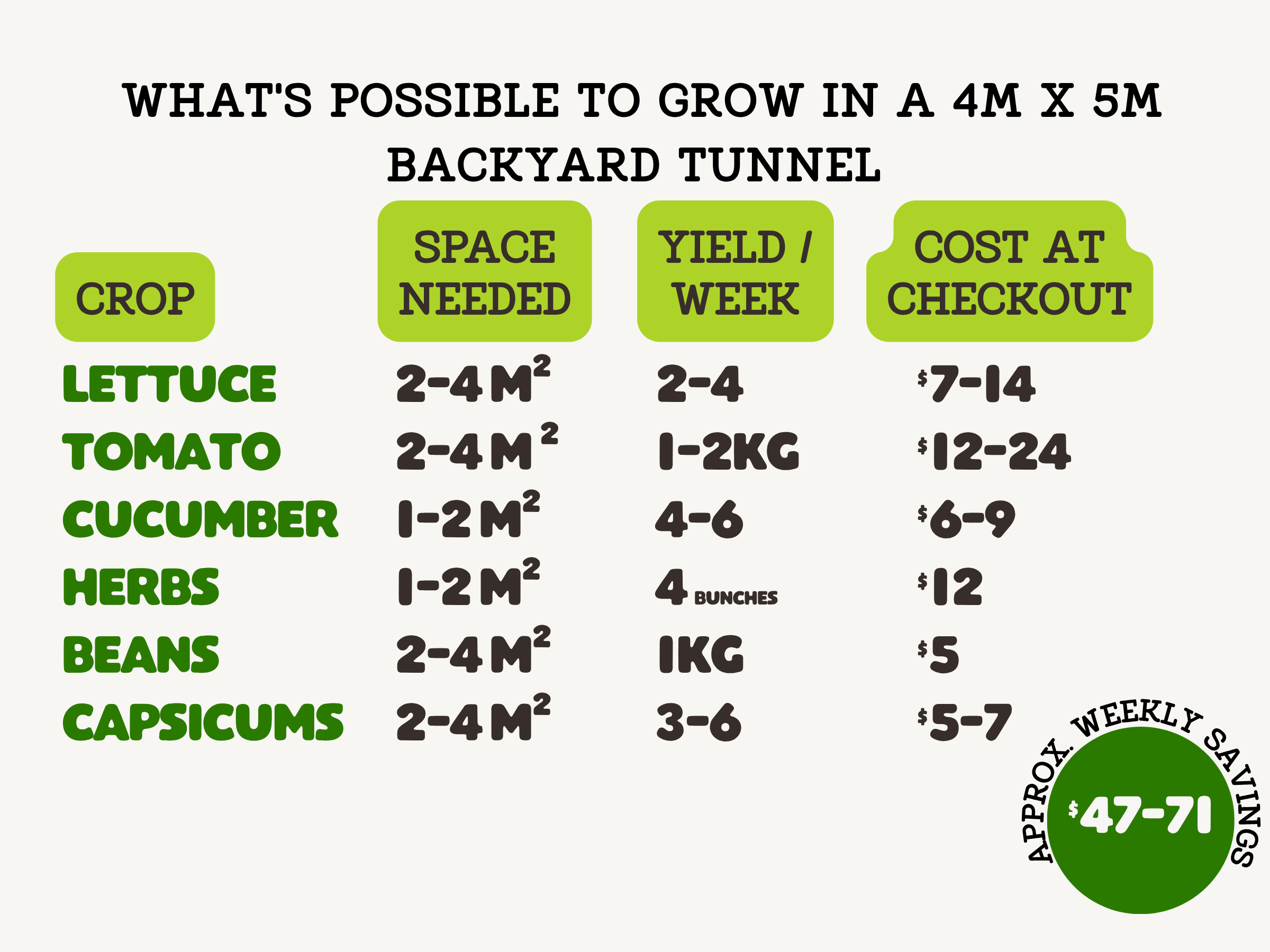
Results will vary depending on planting, inputs and produce seasonality. Figures should be used as a guide only. Mini GROW Tunnels start at $3450 +gst, allowing you to potentially replace your fruit and veg grocery bill in just one year.
Check out how one grower is using a GROW Tunnel as part of his 100% self-sufficient setup.
How Market Gardeners Measure ROI
Market gardeners tend to view ROI through a business lens. The focus shifts from savings to production.
Key considerations include:
Revenue Per Square Metre
The more productive the growing space, the higher the potential return.
Crop Consistency
Reliable production helps maintain customer relationships.
Season Extension
Selling produce earlier or later than competitors can create significant advantages.
Reduced Crop Losses
Every crop saved contributes directly to profitability.
How Can Market Gardeners Estimate Their Return?
For market gardeners, a useful starting point is how much saleable produce each square metre of growing space can generate over a year.
For crops sold individually, such as lettuce, the calculation is:
Plants per m² × crop cycles per year × saleable proportion × selling price = annual gross revenue per m²
This helps you connect your planting plan with your sales forecast. You’ll then need to deduct the costs of producing and selling those crops.
A Worked Lettuce Example
Consider a hypothetical market gardener with 100m² of planted bed space in their polytunnel dedicated to lettuce. This is the productive growing area, excluding paths, access areas and other unplanted space.
Using the following assumptions:
Plants per m² per crop cycle: 15
Crop cycles per year: 8
Selling price / lettuce: $3.5
Planted growing are: 100m²
If every lettuce reaches saleable size and sells at $5, the calculation is:
15 plants × 8 cycles × $3.50 = $420 per m² per year
Across 100m² of planted beds, that would generate $42,000 in annual gross sales before expenses.
These figures illustrate the calculation rather than predict a guaranteed harvest. Planting density, crop turnaround and achievable prices will depend on your lettuce variety, harvest size, climate, management and customers. Eight cycles also needs to allow time for harvesting, clearing and preparing beds between crops.
Allow for Crop Losses and Unsold Produce
A practical budget should account for plants that fail, produce that does not meet your sales standard and harvests you cannot sell.
Keeping the other assumptions unchanged shows how this affects the result:
100% of planted lettuces sold at $3.50 = $42,000
90% of planted lettuces sold at $3.50 = $37,800
80% of planted lettuces sold at $3.50 = $33,600
Remember, these are estimates only and don’t consider input, labour or infrastructure costs. Use your own records or a small growing trial to estimate a realistic saleable proportion. Base your price on the market you actually supply, whether that be farm-gate, retail, restaurant or wholesale.
To give you an idea on what this looks like with a polytunnel, an 8m Rural GROW Tunnel would give you adequate space to reach this growing capacity: RRP: $15,840+gst.
What Does That Mean for ROI?
Gross sales are the beginning of the calculation. To understand your return, deduct the costs of producing and selling your harvest, including:
Seeds, seedlings and growing inputs
Water and energy
Labour, including your own time
Packaging, transport and selling fees
Maintenance and an allowance for replacing covers and equipment
You’ll also need to establish the full initial investment: the tunnel, delivery, installation, site preparation, irrigation and any additional equipment.
If you’re adding a tunnel to an existing market garden, compare the additional sales and additional costs created by the tunnel with your current growing setup.
A simple payback estimate is:
Total initial investment ÷ additional annual net cash generated = estimated years to recover the investment
Only calculate a payback period once you have credible costs and sales assumptions. For mixed cropping, budget each crop separately and account for the bed space and time it occupies, so you don’t count the same growing area twice.
Start With Your Own Growing Plan
The strongest estimate combines a tunnel quote with a realistic crop plan and a clear route to market.
Start with what your customers want to buy, how much you can reliably grow and sell, and what it costs to deliver that harvest. Then choose a tunnel that supports those goals.
Get a quote for your growing setup →
Why Season Extension Changes The Economics
One of the biggest advantages of protected growing is the ability to extend the growing season.
For home growers this means:
More food throughout the year
Earlier planting
Later harvesting
For market gardeners it means:
More weeks of production
Additional sales opportunities
Better utilisation of growing space
The ability to produce when outdoor growing becomes difficult is often one of the largest contributors to ROI.
The Hidden Costs Market Gardeners Often Forget
Many ROI calculations focus only on sales. However, costs also matter. Protected growing can help reduce:
Replanting Costs
Fewer weather-related failures mean fewer replacement crops.
Labour Costs
Less time spent managing weather-related problems and dealing with weeds, due to the physical barrier protecting from airborne weed seed.
Water Waste
Improved irrigation efficiency supports more productive use of resources.
Production Variability
Consistency helps simplify planning and forecasting. Reducing costs is often just as important as increasing revenue.
Loss of crops
Not every crop is going to thrive and survive, so don’t base your profit-margins on 100% success rate. However, growing in a polytunnel can reduce losses from diseases, pests and critters, like wallabies, birds and rabbits, that like to munch on your produce when you’re not looking!
Which Tunnel Delivers The Best Return?
The answer depends entirely on your goals.
Mini Tunnels
Ideal for:
Families
Hobby growers
Backyard food production
Small acreages
The return is often measured through food production, grocery savings and lifestyle benefits. Check out the Mini GROW Tunnel here.
Rural Tunnels
Ideal for:
Market gardeners
Schools
Community gardens
Small farms
Larger-scale food production
The return is often measured through productivity, efficiency and growing capacity. Check out the Rural GROW Tunnel here. Or if you’re going even larger scale, our Commercial GROW Tunnel might be better suited to your needs.
Why Reliability Is The Real Return
When growers discuss ROI, they often focus on dollars.
However, one of the biggest returns a tunnel provides is reliability.
Reliability means:
Fewer surprises
Better planning
More consistent harvests
Greater confidence
Whether you're feeding your family or supplying customers, reliability creates value.
Is A Polytunnel Worth It?
For many growers, the answer is yes.
The question isn't whether a tunnel costs money.
The question is whether the benefits outweigh the investment.
For home growers, the benefits often include:
Reduced grocery bills
Better food quality
Improved food security
For market gardeners, the benefits often include:
Increased production
Improved consistency
Greater profitability
Both outcomes stem from the same advantage:
A more controlled growing environment.
Frequently asked questions about polytunnel ROI
-
Many home growers experience significant value through food production, reduced grocery spending and greater food security. Depending on the size of your tunnel and what you’re growing, you could see your initial investment replace what you would have spent on groceries in under a year.
-
Most market gardeners consider production capacity, revenue, season extension, labour efficiency and crop losses. If you’re starting out, you’ll need to build the initial cost of your tunnel into that for the first few years too.
-
We always say the best crops are the ones that there is a market for. Before deciding what you’ll grow, determine if there’s a buyer for it. Whether that’s selling at your front-gate, to local cafes and restaurants or the grocer down the road. Then, after you know what’s needed, you might consider some high-yield crops such as tomatoes, salad greens, herbs, cucumbers and microgreens are often among the highest-value crops for both home and commercial growers. Check out our blog post ‘Growing vegetables in polytunnels: Your guide to profitability’ for more guidance on picking the best crops to boost your ROI.
-
Protected growing environments can significantly reduce losses caused by weather and environmental stress. By providing a physical barrier from heavy rain, winds and pests, you can reduce crop losses and boost yields.