
Polytunnel Covers Explained: Plastic vs Solarweave
What is the best polytunnel cover in Australia?
The best polytunnel cover depends on your goals, but Solarweave is commonly preferred for long-term growing in Australian conditions due to its durability and performance.
The cover you choose directly impacts yield, crop protection, and long-term cost.
Polyethylene (plastic) covers may be cheaper upfront but degrade faster in Australian conditions.
Solarweave offers significantly greater durability, protection, and long-term performance.
Choosing the wrong cover often leads to hidden costs through lost production, replacements, and downtime.
The Cost of Choosing the Wrong Cover
When choosing their polytunnel, most growers naturally start by comparing prices.
It’s a logical place to begin. The upfront difference between options can feel significant. But the real cost of a tunnel isn’t what you pay on day one. It’s what happens after you start growing.
When a cover degrades faster than expected, fails under pressure, or simply doesn’t create a stable growing environment, the cost shows up elsewhere:
lost crops
reduced yields
inconsistent quality
more time spent managing issues
earlier replacement than planned
This is where the conversation shifts. The structure isn’t the cost. The losses are.
Why the Cover Is the Most Important Part of Your Tunnel
Your frame holds the structure together, but your cover creates the growing environment.
It directly influence:
how much usable light your crops receive
how stable your internal climate remains
how well your crops are protected from weather
how consistently your system performs over time.
If the cover underperforms, everything inside it does too.
That’s why experienced growers don’t treat the cover as a minor detail. They know that it is a core part of production.
What Happens When You Use a Standard Plastic Cover?
Polyethylene (PE) film is widely used in entry-level tunnels because it is inexpensive and easy to source. For short-term use, it can be sufficient. But in Australian conditions, its limitations tend to appear quickly.
Common Issues with Plastic (PE) Covers
UV exposure causes degradation, weakening and clouding the material
Increased risk of tearing under wind or weather pressure
Light transmission reduces over time as the film ages
Shorter lifespan leads to more frequent replacement cycles.
While the upfront cost may be lower, these factors often lead to reduced performance and increased long-term cost.
The Hidden Cost: It’s Not Just the Cover
When a cover underperforms, it doesn’t just affect the structure — it affects production.
Even small inefficiencies compound:
slightly reduced light → slower plant growth
less protection → increased plant stress
inconsistent conditions → uneven output
Over a season, this adds up.
A 10–20% drop in production can outweigh the initial savings of a cheaper cover.
And while this is often discussed at commercial scale, the same principle applies to backyard growers. When space is limited and food production matters, consistency becomes just as valuable.
What Makes Solarweave Different (At a Material Level)
Solarweave is not just a thicker plastic — it is a different material system designed for long-term horticultural use.
It is constructed using a woven high-density polyethylene (HDPE) base fabric, coated on both sides with UV-stabilised low-density polyethylene (LDPE).
This structure gives it very different performance characteristics compared to standard plastic film, including:
significantly higher tensile strength and tear resistance
improved resistance to punctures and wind stress
greater stability under prolonged UV exposure
stronger integrity for long-term installations.
In practical terms, this means the cover maintains its structure and performance over time, rather than gradually degrading.
Light Transmission and Crop Performance
One of the most important (and often overlooked) differences between covers is how they manage light.
Solarweave is designed to balance light transmission and diffusion, supporting more consistent plant growth.
Depending on the variant, can filter between 16% – 40% of light (on average). During hot Australian summers, this is crucial. Whilst plastic (PE) covers provide a physical barrier, they don’t provide any protection from harsh sunlight, significantly increasing the temperature inside your greenhouse.
This matters because plants don’t just need light, they need usable, consistent light.
Furthermore, as plastic covers age, they often become cloudy or uneven, reducing the amount and quality of light reaching your crops. Over time, this can slow growth, delay harvests, and reduce overall productivity.
Strength and Durability in Real Conditions
Solarweave is engineered for structural performance, not just coverage.
It offers:
high tensile strength for load resistance
strong tear resistance under tension
high burst strength for durability under pressure.
In real-world conditions, this translates to:
better resistance to wind events
reduced likelihood of tearing or failure
longer service life under constant exposure
For growers, this means fewer disruptions, fewer repairs, and a system that keeps working when it matters.
Plastic vs Solarweave: Real-World Growing Impact
On paper, the differences between plastic and Solarweave can seem small.
In practice, they show up in how your tunnel performs day after day, season after season.
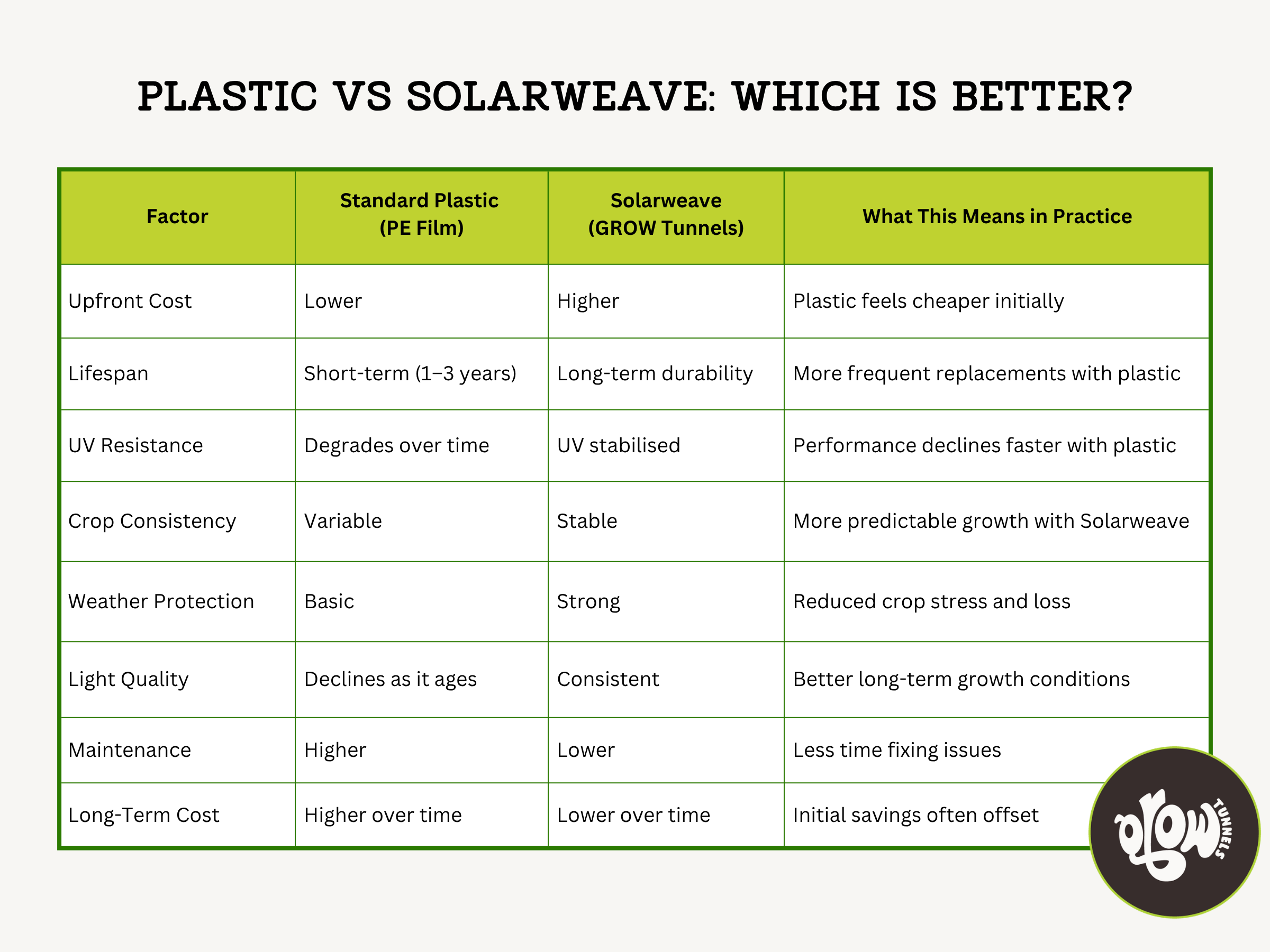
The difference isn’t just what the material is — it’s how your growing system performs over time. And that’s where most of the real cost sits.
Why This Matters for Backyard Growers Too
There’s a common assumption that material quality only matters at commercial scale.
But in reality, backyard growers often feel the impact sooner.
When space is limited, every square metre counts. When you’re trying to produce food consistently, reliability matters.
A more durable cover helps remove variability and creates a system you can depend on — not just experiment with.
The Bigger Question: What Are You Building?
At some point, the decision stops being about materials. It becomes about intent. Are you building something temporary? Or are you building a system you can rely on season after season? Because those are two very different approaches — and they lead to very different outcomes.
How GROW Tunnels Approach Cover Performance
GROW Tunnels use Solarweave covers combined with galvanised steel frames and systems designed for long-term use in Australian conditions.
That combination is deliberate.
It’s not just about durability — it’s about consistency.
consistent protection
consistent growing conditions
consistent output over time
Because ultimately, that’s what growers are looking for. Not just a structure. A system that works.
Final Thoughts
The cover you choose shapes everything that happens inside your tunnel.
It affects how your crops grow, how your system performs, and how much value you get from the investment over time.
A plastic cover may get you started. But if your goal is reliability, durability, and consistent production then it’s worth choosing a solution built to handle real conditions.
Because in the end, the biggest cost isn’t the structure you choose. It’s what happens if it doesn’t perform.
Planning a tunnel that actually performs long-term?

FAQs
What is the best polytunnel cover for Australia?
Solarweave is often preferred for its durability and performance in harsh Australian conditions.
How long does plastic polytunnel cover last?
Typically shorter than woven alternatives, especially under strong UV exposure.
Is Solarweave worth the extra cost?
For growers focused on long-term performance and reliability, yes.
Does cover choice affect yield?
Yes — light, protection, and environmental stability all impact plant growth and output.
Can backyard growers benefit from better covers?
Absolutely. Reliability and consistency matter at every scale of growing.